
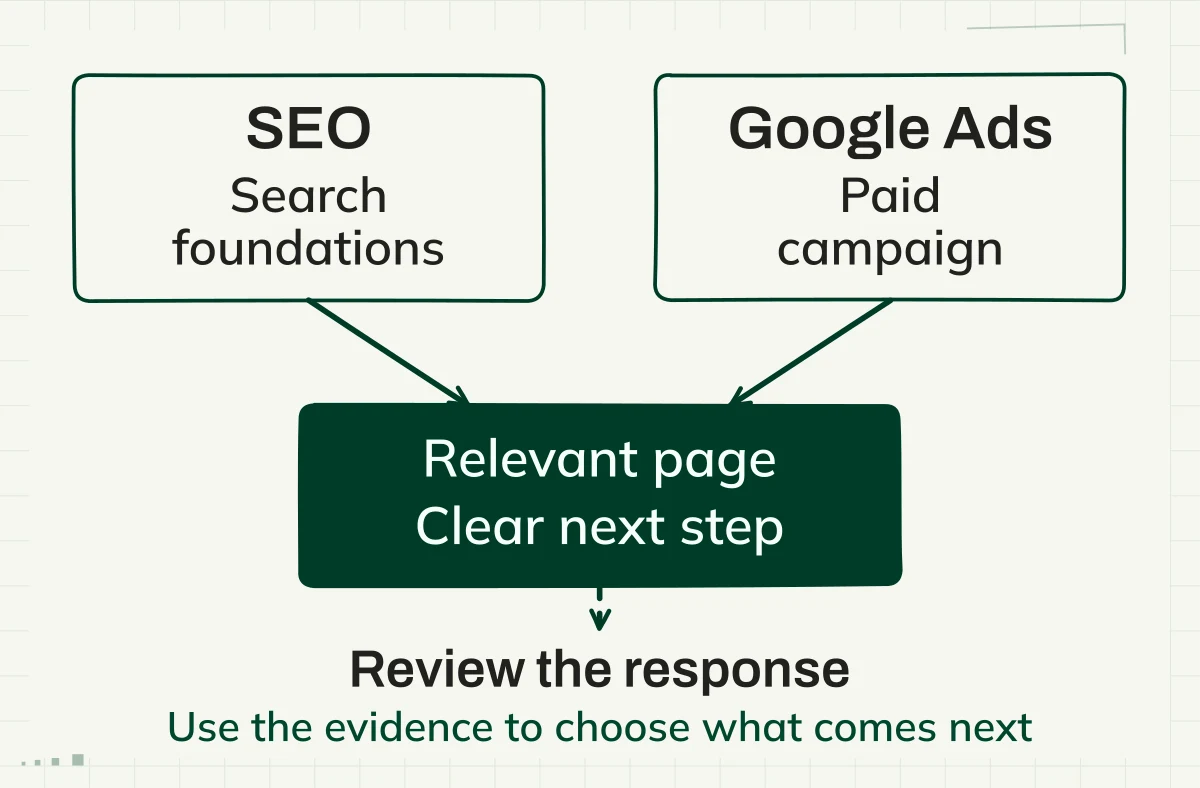
When you are deciding where to put a marketing budget, start with the work you want more of. Who needs it, how do they look for it and what would help them choose you? SEO and Google Ads can both belong in that plan. The starting point depends on the offer, the website, the budget and your capacity to respond.
Give the investment a clear job.
A broad goal such as more leads leaves a lot unresolved. You might need enquiries for a particular service, a different type of job or work in an area you can realistically cover. Your availability and the information needed to assess a request belong in the conversation too.
Bring a website link, a few customer questions and what you have tried already. Research can then look at how people search, the results they encounter and the page you would send them to. That gives the choice a business context before anyone recommends a channel.
Understand what each route asks of the business.
SEO work improves the website's content, structure and search foundations so relevant information has a better opportunity to be found. That can involve clearer service pages, useful guides, local business details and technical repairs. Its response needs to be measured over time, with the work and the observed result kept distinct.
Google Ads search campaigns pay for advertising opportunities around relevant searches. They need an agreed budget, suitable targeting, useful ad copy and a page that follows through on the offer. Advertising with Google does not buy a better position in the ordinary, non-advertising search results.
Source info
Check where the click will take someone.
A person checking whether you cover their area needs an accurate answer whichever route brought them to the site. Someone comparing products may need sizes, limitations, examples or delivery information before they are ready to enquire.
If those answers are missing, improving the page may be the first useful piece of work. Check the next step as well: what information the form asks for, where the enquiry is saved and who responds. A campaign and its destination should make sense together. Website changes belong in the agreed scope.
Agree what would make the effort worthwhile.
Choose measures that fit the decision: relevant search visits, enquiries for the intended service and suitable opportunities where the records can establish them. Keep tests, spam and repeated submissions separate. A click, a recorded form action and a customer are different things.
For advertising, distinguish media spend from management, production and website costs. Decide what will be reviewed and which period gives a fair comparison. Recent enquiries may still arrive after earlier clicks, so a cost figure for the latest few days may change. Reporting should explain that timing.
Source info
Choose a starting scope you can judge.
That might be a search and website review, an improvement to one important service page, a focused campaign or a plan that connects both channels. There is no need to commission every part at once. The first recommendation should explain what it will help you learn and what is needed from you.
At Knighton, we work through those choices with you and make the proposed work tangible. You should be able to see the priority, the costs, the responsibilities and how the next review will guide the decision to continue or change direction.
Put it to use
A useful check for your business.
- Which service, customer and area should the work support?
- Does the destination answer the buying question and offer a workable next step?
- Which costs and results will the review include?
- What will we learn before making the next commitment?
Source info & further reading
Our practical interpretation, with the references below for the specific principles and further detail.
- Do you need an SEO?
The role of SEO work and the distinction between Google advertising and organic search inclusion or ranking.
- Best practices for generating high-quality leads
Choose conversion goals around the lead-to-sale journey and business aims; this is platform guidance, not a promised campaign result.
- About conversion lag reporting
Later conversions can change recent campaign cost-per-acquisition and return-on-ad-spend readings.